
 Indochina destination specialist
Vietnam · Gulf of Tonkin
Lan Ha Bay, the same water as Ha Long
One karst field in the Gulf of Tonkin, cut in two by a provincial boundary. Ha Long is entered from Quang Ninh and carries most of the fleet. Lan Ha is entered from Haiphong and carries a fraction of it, for the same limestone.
At a glance
Lan Ha and Ha Long are the same bay
This is the single thing worth understanding before you book anything here, and most websites blur it deliberately.
The limestone towers of the Gulf of Tonkin form one continuous drowned karst landscape of roughly sixteen hundred islands. An administrative line runs through it. North of the line is Ha Long Bay and Bai Tu Long, in Quang Ninh province, entered from Tuan Chau and Ha Long City. South of it is Lan Ha, about four hundred islands, in Haiphong, entered from Got pier and from Cat Ba island. The rock is the same rock. The water is the same water. Nobody standing on a deck can tell you which side of the line they are on without looking at a chart.
What differs is traffic. The Ha Long side licenses several hundred overnight boats and a much larger day fleet, and they work a small number of the same caves and the same anchorages, so the well-known stops can hold thirty boats at once. Lan Ha has a fleet in the dozens rather than the hundreds, with the same scenery and more places to put an anchor down. That is the whole argument for it, and it is enough of one.
Where Lan Ha is not quiet: Cat Ba town. The island town is a building site with a cable car across the channel and a seafront of new hotel blocks, and the water immediately around it is working harbour. If a boat sells you Lan Ha and then moors off Cat Ba town for the night, you have bought the name and not the thing. Ask where the boat overnights, by name of anchorage, before you pay.
How many nights aboard
One night is the minimum that makes the drive worth doing, and two is the version that actually works.
A one-night boat boards around 12:00 and disembarks around 11:00 the next day. Subtract the safety briefing, lunch, the kayak hour, dinner, sleep and breakfast, and you have roughly four hours of usable daylight on the water, most of it inside the zone the day boats also use. You get one sunrise and no second chance at weather.
The second night is what buys the southern anchorages, an entire day with no transfer at either end, and a morning where the boat is somewhere the day fleet cannot reach and turn around from. In our experience, the guests who come back saying the bay was the best part of the trip are almost all on two-night boats.
A day trip from Hanoi is five hours of driving in exchange for about four hours afloat, all of it in the busiest water. We will book it if you insist and your dates are immovable, but we will tell you first that it is the weakest day in any northern itinerary.
When to go
1 = cold, wet or storm risk · 2 = workable · 3 = the months we would pick
| Months | Air and sea | What it means on a boat |
|---|---|---|
| October to December | 20 – 27 °C, sea calm | The best window. Clear air, flat water, swimming still possible in October. |
| January to February | 14 – 19 °C, grey | Cold on deck, thick mist. The karsts look exactly like the photographs everybody loves, and you will not swim. |
| March to April | 20 – 27 °C, improving | Our other preferred window. Haze increases through April but the water warms. |
| May to June | 27 – 33 °C, warm sea | Best swimming of the year, hazy light, afternoon thunderstorms building. |
| July to August | 29 – 35 °C | Hot, and the storm season. Boats do not sail when the port authority closes the bay. |
| September | 26 – 32 °C | Typhoon remnants, then some of the clearest days of the year between them. |
When a tropical storm is forecast, the Haiphong port authority closes the bay and every boat stays alongside. This happens a handful of times each summer. If it happens on your date we move you to a land night and refund the cabin, but no operator can sail out of it, and any company that promises you otherwise is describing a decision that is not theirs to make.
Getting here
Everyone comes through Hanoi. The expressway to Haiphong opened the route up: what used to be four hours is now two and a half on good road, with one service area.
| Route | Time | Rough cost |
|---|---|---|
| Hanoi to Got pier by private car | 2 h 30, 130 km | USD 75 – 95 one way, the car |
| Hanoi to Got pier by shared limousine van | 3 h with pick-ups | USD 15 – 20 per person |
| Got pier to the boat, by tender | 20 – 45 min | Included in a cruise fare |
| Hanoi to Cat Ba town via ferry | 3 h 30 – 4 h | USD 20 – 30 per person |
| Noi Bai airport direct to Got pier | 2 h 45 | USD 95 – 115, the car |
| Onward to Ninh Binh by road | 3 h, 175 km | USD 90 – 110, the car |
Boats board between 11:30 and 12:30 and will not wait, so a same-day arrival from a long-haul flight is a bad idea: one delayed landing and you have paid for a cabin you never boarded. Sleep in Hanoi first.
What things cost on the ground
Almost everything here is bought as a cabin fare, which is why the separate prices are hard to find. These are the working numbers.
| Item | Typical price | Note |
|---|---|---|
| Mid-range cabin, per person per night | USD 130 – 180 | Twin share, all meals aboard, kayaks included |
| Better boat, per person per night | USD 220 – 330 | Larger cabins, private balcony, smaller passenger count |
| Private charter, a small wooden boat | USD 900 – 1,500 per night | The whole boat, four to eight guests, crew and meals |
| Hotel in Cat Ba town, per night | USD 25 – 60 | Useful only as a land alternative in bad weather |
| Cat Ba National Park entry | VND 80,000 (USD 3.20) | Plus a guide if you walk the Viet Hai trail |
| Bay route and anchorage fees | VND 250,000 – 600,000 | Normally already inside the cabin fare; ask if it is not |
| Drinks aboard, a beer | USD 2.50 – 4 | Boats mark drinks up; nothing else is worth arguing about |
| Cooking class or squid fishing aboard | Usually included | If a boat charges extra for these, it is a cheap boat |
Lan Ha in five frames


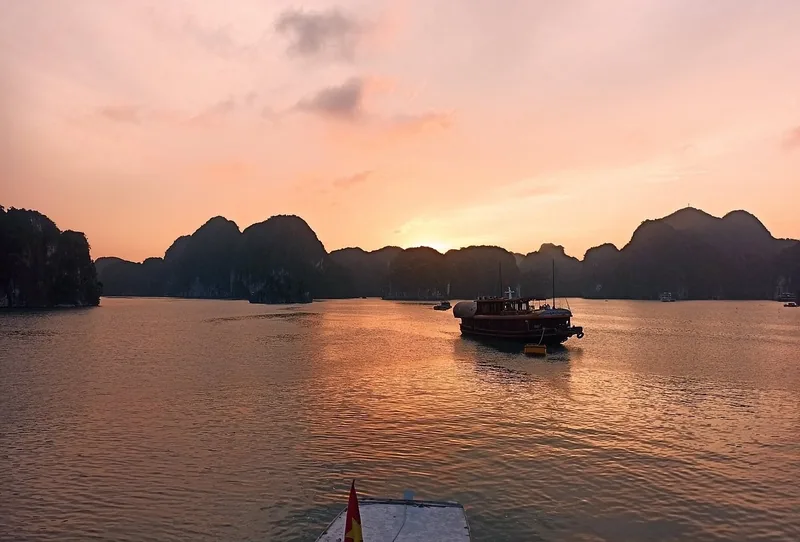
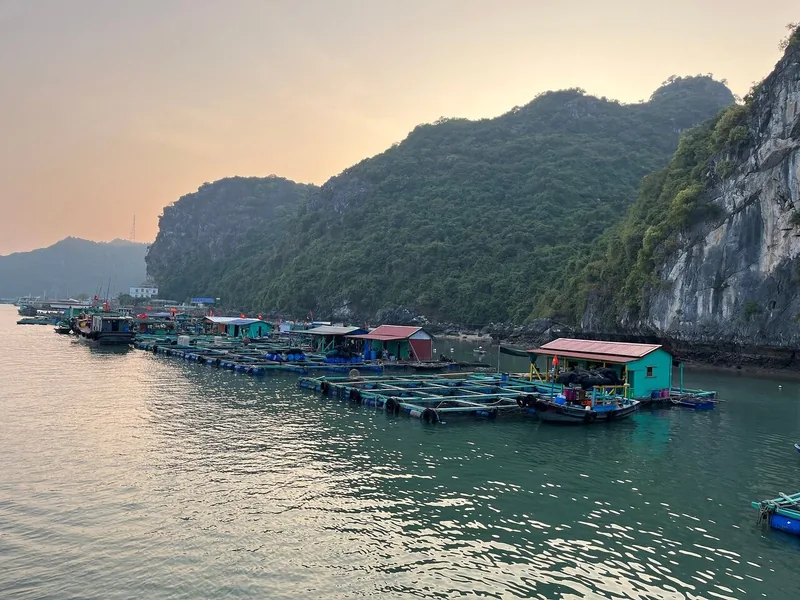

Trips that include the bay
A night in Lan Ha sits on day four of the Vietnam north to south route and on the same day of the Classic Indochina route, in both cases with the boat leaving from Got rather than from the Ha Long side.
Families usually want the two-night version with more swimming and less cave, which is how it is built into the eleven-day family route. Walkers who would rather be on Cat Ba than on a deck can take the island trail instead, and that swap is already priced into the northern Vietnam walking route.
Plan My Trip
A night aboard, on a route that earns it
Twelve days: Hanoi, Lan Ha, Hue, Hoi An and the delta, with the full day plan and price table.
When to skip the bay
- You get seasick easily. The bay is sheltered and the boat barely moves at anchor, but the transfer out and the tender rides are open water in a small hull, and there is no way off once you have sailed.
- You cannot manage a ladder or a step down onto a moving tender. Every boat requires both, several times, and in a swell the crew cannot make it safe for someone with poor balance.
- Your dates are in July or August and cannot move. One storm closes the port and the day disappears, and that risk is real rather than theoretical.
- You already have Ninh Binh in the plan and only one spare night. Ninh Binh is the same limestone with rice fields instead of sea, and doing both as one-night stops gives you a shallow version of each.
- You want a hotel with a pool and a bay view instead of a cabin. That exists on the Ha Long side and on Cat Ba, and if that is what you want, say so and we will book that rather than sell you a boat.
Common questions
Questions travellers ask most
Is Lan Ha better than Ha Long Bay?
The scenery is identical because it is the same karst field. Lan Ha carries far fewer boats, so the anchorages are quieter and the caves are not queued. That is the only real difference, and for most people it is the one that matters.
Can I put Ha Long Bay on my itinerary instead?
Yes, and some people want the name on the document. Say so and we will book a boat from the Quang Ninh side at a similar standard. The drive is about half an hour longer and the anchorages are busier.
What actually happens on a one-night cruise?
Board around noon, lunch while the boat moves out, kayak or swim in the afternoon, sunset at anchor, dinner aboard, then a quiet evening because there is nowhere to go. Next morning there is a cave or a beach before an early brunch, and you are back at the pier by eleven.
Are the boats safe?
Licensed overnight boats are inspected and carry life jackets in every cabin and on deck. The parts to check are the age of the hull, whether the operator runs its own boat or sells cabins on someone else's, and where it overnights. We charter from a short list and can tell you the boat name before you pay.
Related
Read next

Vietnam · Red River delta
Hanoi
The capital of Vietnam: old quarter, lake, and the best street food in the country.
View journey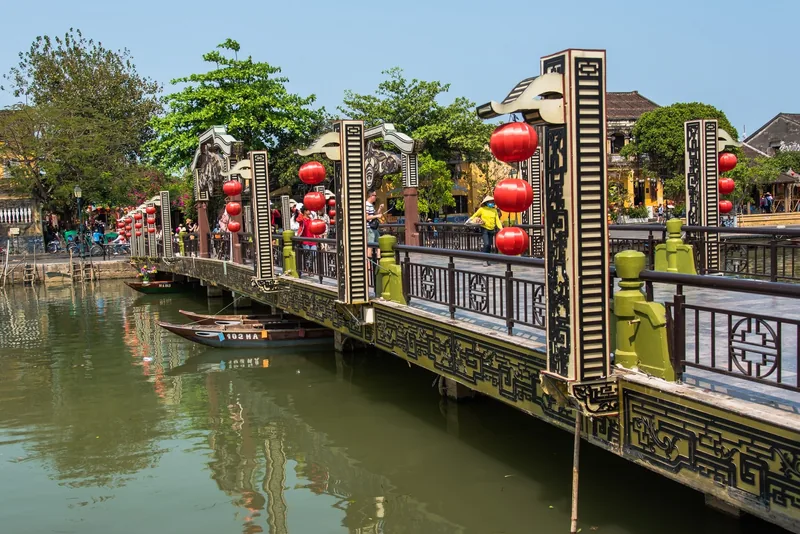
Vietnam · Quang Nam coast
Hoi An
Central Vietnam: preserved old town, tailors, river, and a beach fifteen minutes away.
View journey
Example itinerary — fully customizable
Vietnam north to south
Twelve days, one country, three climates and two internal flights.
View journey
Example itinerary — fully customizable
Classic Indochina
Fifteen days, three countries, nothing shorter than a two-night stop.
View journey
Planning
When to go
Month-by-month conditions across Vietnam, Cambodia and Laos, including what the quiet season is good for.
View journey
Destination guide
Vietnam
The long country: three climates, ten to fourteen nights, and where it is worn out.
View journey
Start planning
Tell us about the journey you have in mind
Dates, party size and the places you care about are enough to start. You get a draft route and an indicative price, not a brochure.
Prefer to talk? WhatsApp or call+84 766 019 399