
 Indochina destination specialist
Vietnam · The south
The Mekong Delta, past the day trip
Forty thousand square kilometres of farmed, drained, engineered floodplain holding about seventeen million people. The day trips from Ho Chi Minh City show you the first ninety minutes of it. The rest is where anything happens.
At a glance
What the delta actually is
This is not a wilderness and it has not been one for three hundred years. The delta is an agricultural machine: a plain the size of Denmark, cut by something over twenty-five thousand kilometres of canals, most of them dug by hand or dredged, producing more than half of Vietnam's rice and most of its fruit and farmed fish. The interest of the place is the density of human work in it, not its wildness. Anyone arriving expecting jungle will be disappointed by lunchtime.
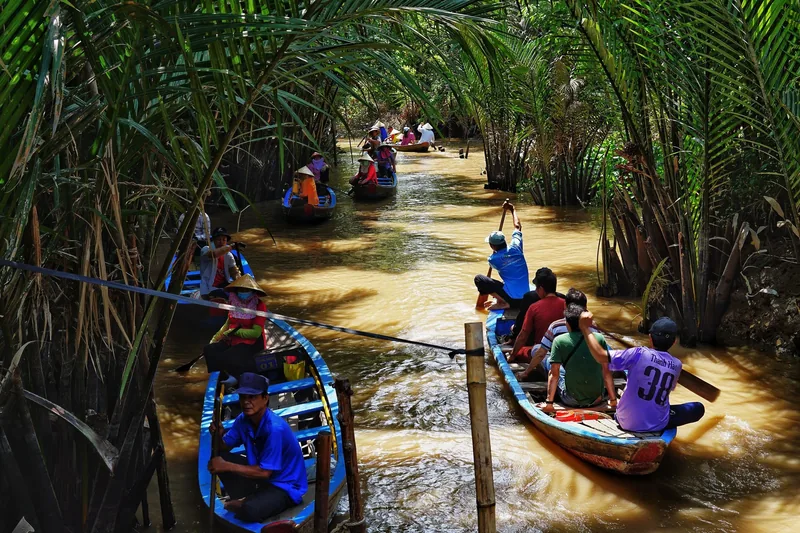
The version sold as a day trip from Ho Chi Minh City runs to My Tho or Ben Tre, ninety minutes out, and it is a conveyor. The sequence is fixed: a motorised boat to an island, a coconut candy workshop, honey tea with a python around your neck for a photograph, a sampan paddled down a short canal wearing a conical hat, a lunch hall for two hundred people, and back. Thousands of people do it every day and most of them leave thinking the delta is a tourist product. It is a fair conclusion from that evidence.
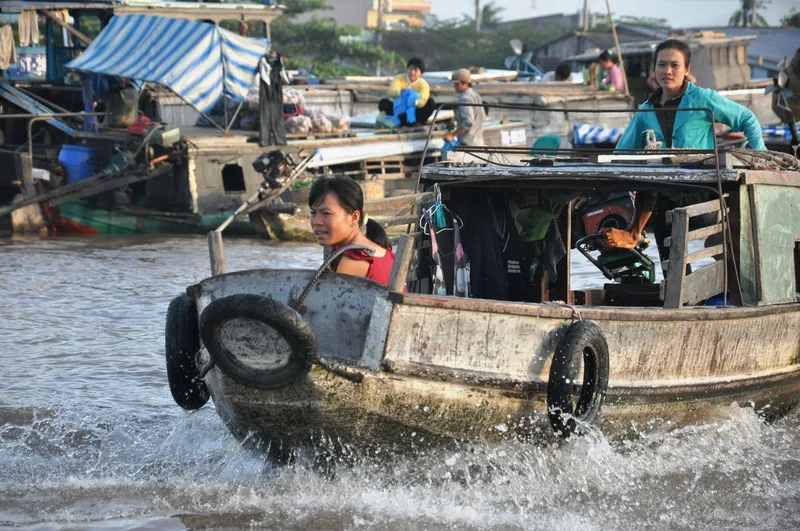
The floating markets are the other thing worth being honest about. Cai Rang, outside Can Tho, is a genuine wholesale market where boats sell produce by the tonne with a sample hung on a pole, and it is done by around 08:00. It has also shrunk: as roads and bridges reached the villages, trade moved onto lorries, and the fleet is a fraction of what it was twenty years ago. It is still worth a 05:30 start. Phong Dien is smaller and more local. Cai Be, closer to the city, is now mostly a stop for boats carrying visitors.
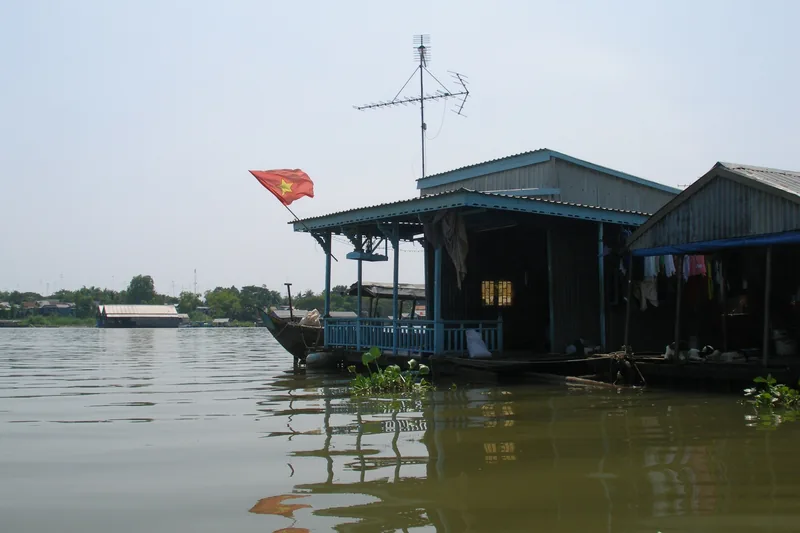
Where the delta earns three nights: Tra Vinh with its Khmer monasteries and the oldest tree-lined lanes in the south; Sa Dec, a flower-growing town of colonial merchant houses; Chau Doc under Sam mountain near the Cambodian border, with its floating fish farms and Cham villages; and Tram Chim national park in Dong Thap, which is the closest the region comes to what it looked like before the canals.
How many nights, and why one breaks it
Two nights, minimum, and they should be at least three hours from Ho Chi Minh City.
One night is a three-and-a-half-hour drive down, an afternoon, a night, one market morning and a three-and-a-half-hour drive back. That is seven hours in a vehicle for a single sunrise, and if that sunrise is grey you have bought nothing. It is the most common mistake in southern itineraries.
Two nights gets you a market morning with a spare morning behind it, a full day of canals and orchards on small boats rather than the transfer boats, and an evening in a town where nobody is selling anything to a visitor. Three nights lets you go on to Chau Doc or Tra Vinh, which is where most people would rather have spent the time if they had known.
A homestay night is worth taking for one night and not two. The good ones are family houses with four to eight rooms, mosquito nets, thin walls and a shared bathroom in some cases; the food is better than any hotel in the region. The second night is better spent somewhere with air conditioning and a door that locks, and nobody who has done both disagrees.
When to go
1 = heat or heavy rain · 2 = workable · 3 = the months we would pick
| Months | Daytime range | Rain | What it is actually like |
|---|---|---|---|
| November to February | 24 – 32 °C | 20 – 80 mm/month | The dry season and the best window: cooler mornings, firm tracks, clear water. |
| March to April | 27 – 37 °C | Under 50 mm/month | The hottest of the year. Canals low, boats stir up mud, and midday is unworkable. |
| May to August | 26 – 34 °C | 200 – 300 mm/month | Afternoon storms of one to two hours, mornings mostly clear. Green, cheap and quiet. |
| September to November | 25 – 33 °C | 250 – 350 mm/month | The high water season. The upper delta floods on purpose and the plains fill; best time for Tram Chim and Chau Doc. |
The flood here is not a disaster, it is the agricultural calendar. Farmers in Dong Thap and An Giang open the dykes so the fields take silt and fish, and the landscape between September and November is a sheet of water with treetops and roof lines in it. It is the most photogenic the delta ever gets and the least comfortable to travel around, and those two facts are connected.
Getting here
Everything starts in Ho Chi Minh City. The expressway has cut the run to Can Tho to about three and a half hours; beyond Can Tho the roads are provincial and slower than the map suggests.
| Route | Time | Rough cost |
|---|---|---|
| Ho Chi Minh City to My Tho | 1 h 45, 70 km | USD 60 – 80, the car |
| Ho Chi Minh City to Ben Tre | 2 h, 85 km | USD 70 – 90, the car |
| Ho Chi Minh City to Can Tho | 3 h 30, 170 km | USD 110 – 140, the car |
| Ho Chi Minh City to Can Tho by coach | 4 h | USD 8 – 12 per person |
| Hanoi to Can Tho by air | 2 h 05 | USD 50 – 110 one way |
| Can Tho to Chau Doc | 3 h, 115 km | USD 90 – 120, the car |
| Chau Doc to Phnom Penh by river | 5 – 8 h with the border | USD 35 – 60 per person |
| Cai Rang market by boat from Can Tho | 30 min each way | USD 25 – 45, the boat |
The river crossing to Cambodia is the reason many people come here rather than flying. It is slow, the border formalities at Vinh Xuong take time, and it is the only land or water frontier in the region that feels like an arrival rather than a queue.
What things cost on the ground
| Item | Typical price | Note |
|---|---|---|
| Hotel in Can Tho, per night | USD 30 – 70 | The only town with a proper choice of hotels |
| Riverside boutique or heritage, per night | USD 110 – 170 | A short list, mostly in Can Tho and Chau Doc |
| Homestay, per person per night | USD 25 – 50 | Includes dinner and breakfast almost everywhere |
| Hu tieu or bun noodles, a bowl | USD 1.20 – 2 | The southern breakfast |
| Lunch at a garden restaurant, per person | USD 5 – 10 | Elephant ear fish and a pile of herbs, for two to share |
| Private sampan for two to three hours | USD 25 – 45 | The whole boat, paddled, in the small canals |
| Motorised boat to Cai Rang, return | USD 25 – 45 | Leave the pier at 05:15 to be there before the trade ends |
| Tram Chim national park entry and boat | USD 8 – 25 per person | Depends on which of the three circuits you take |
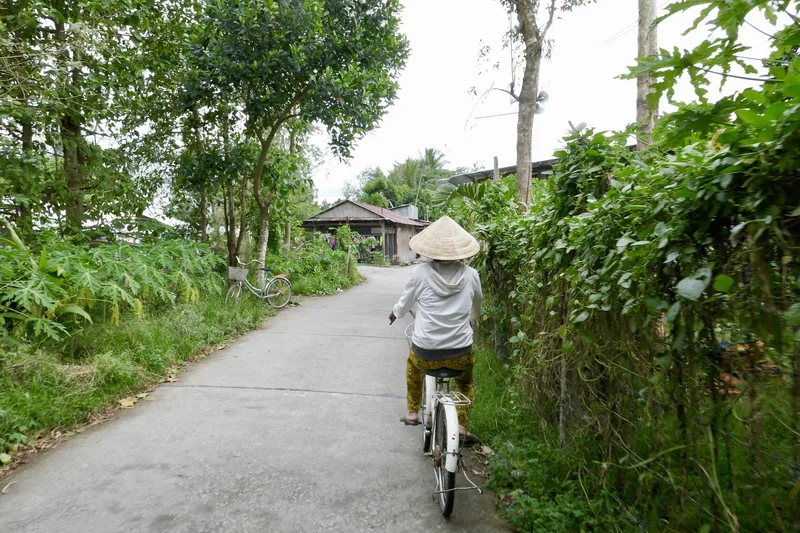
| Bicycle hire for a day | USD 2 – 4 | The dyke paths are flat and mostly concrete |
The delta in five frames
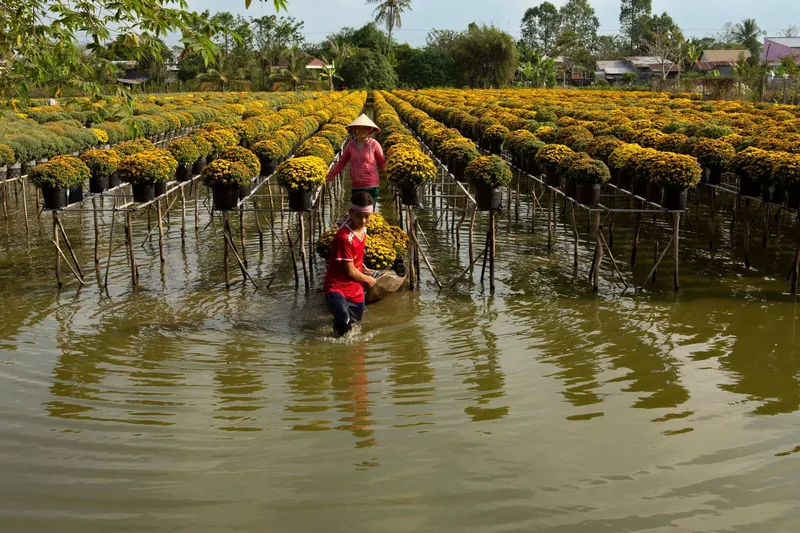
Trips that come down here
The delta closes the Vietnam north to south route with two nights past Can Tho rather than a day trip from the city, which is the main reason that route is twelve days and not ten.
If you are crossing to Cambodia, the Angkor and the Cambodian Mekong route picks the river up on the other side of the border and follows it to Phnom Penh, and the two can be joined. Families usually prefer the orchards and the bicycles to the markets, and that version sits inside the eleven-day family route.
Plan My Trip
Two nights in the real delta
Twelve days from Hanoi to the south, with the delta given proper time instead of a day trip.
When to skip the delta
- You have one spare night. A one-night delta trip is seven hours of driving for one morning, and almost everyone who does it says afterwards it should have been cut.
- Mosquitoes and humidity are a genuine problem for you. Evenings on the water are both, every month of the year, and repellent only takes the edge off.
- You are expecting wildlife or untouched landscape. This is farmland with water in it. Tram Chim has birds, and everywhere else the animals are livestock.
- You cannot manage a step down into a low boat from a floating jetty, often without a handrail. Every worthwhile hour here starts with that step.
- Your dates are in March or April and you cannot start at 05:30. By 10:00 it is 35 degrees with no shade on the water, and the day is effectively over.
Common questions
Questions travellers ask most
Is the day trip from Ho Chi Minh City worth doing at all?
If you have literally one spare day and will not otherwise see the river, it shows you something. Expect a fixed sequence of stops shared with several hundred other people and treat it as a sample rather than a visit. Two nights further down is a different experience entirely.
Are the floating markets still real?
Cai Rang is, in the wholesale hours before about 08:00, and it is smaller than it was because roads took the trade. Phong Dien is smaller and more local. Cai Be near My Tho is now largely arranged for visitors, and we would not send you there for the market itself.
Homestay or hotel?
One night of each is the pattern that works. Homestays give you the food and the family, with thin walls, fans rather than air conditioning in the cheaper ones, and an early start whether you wanted one or not. After two nights of that most people want a real bathroom.
Can I get from the delta into Cambodia?
Yes, by river from Chau Doc through the Vinh Xuong border to Phnom Penh, taking five to eight hours depending on the boat and the queue at immigration. It needs a Cambodian visa arranged in advance for most nationalities, and it is the most interesting way to make that crossing.
Related
Read next
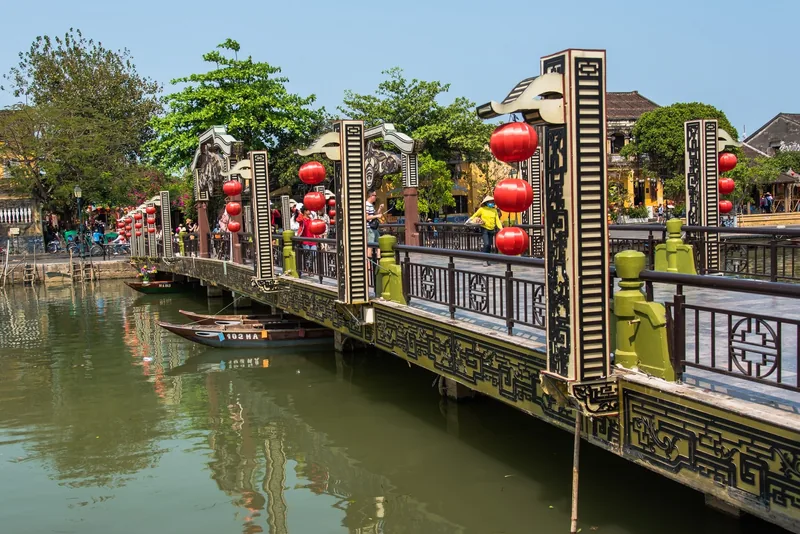
Vietnam · Quang Nam coast
Hoi An
Central Vietnam: preserved old town, tailors, river, and a beach fifteen minutes away.
View journey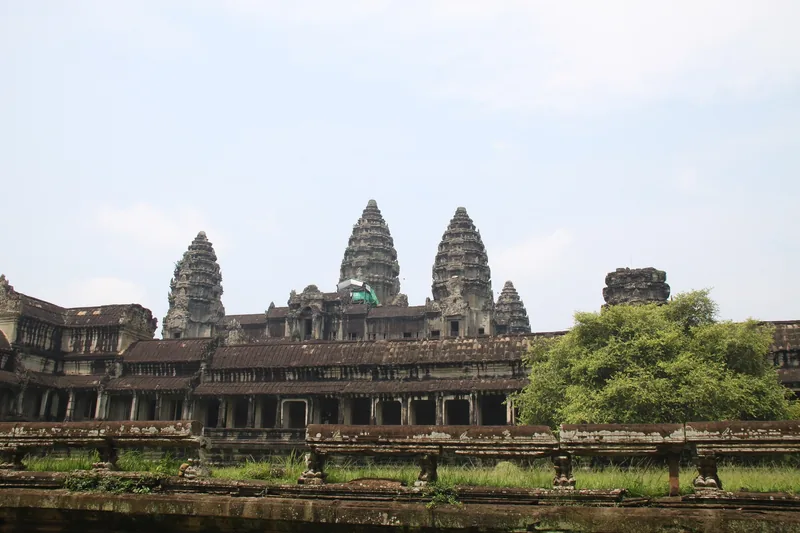
Cambodia · Angkor
Siem Reap
Cambodia: the Angkor temples, and the town that grew around them.
View journey
Example itinerary — fully customizable
Vietnam north to south
Twelve days, one country, three climates and two internal flights.
View journey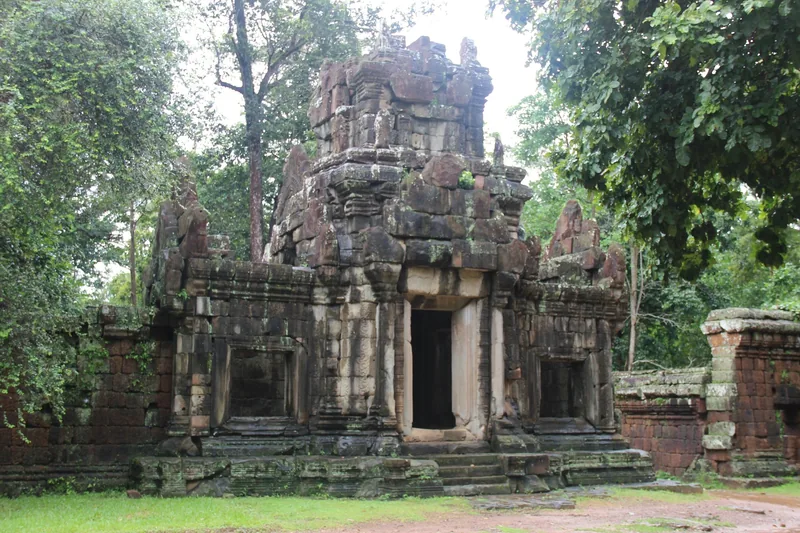
Example itinerary — fully customizable
Angkor and the Mekong
Eight days: Angkor over two days, Battambang, and Phnom Penh.
View journey
Planning
When to go
Month-by-month conditions across Vietnam, Cambodia and Laos, including what the quiet season is good for.
View journey
Destination guide
Vietnam
The long country: three climates, ten to fourteen nights, and where it is worn out.
View journey
Start planning
Tell us about the journey you have in mind
Dates, party size and the places you care about are enough to start. You get a draft route and an indicative price, not a brochure.
Prefer to talk? WhatsApp or call+84 766 019 399